
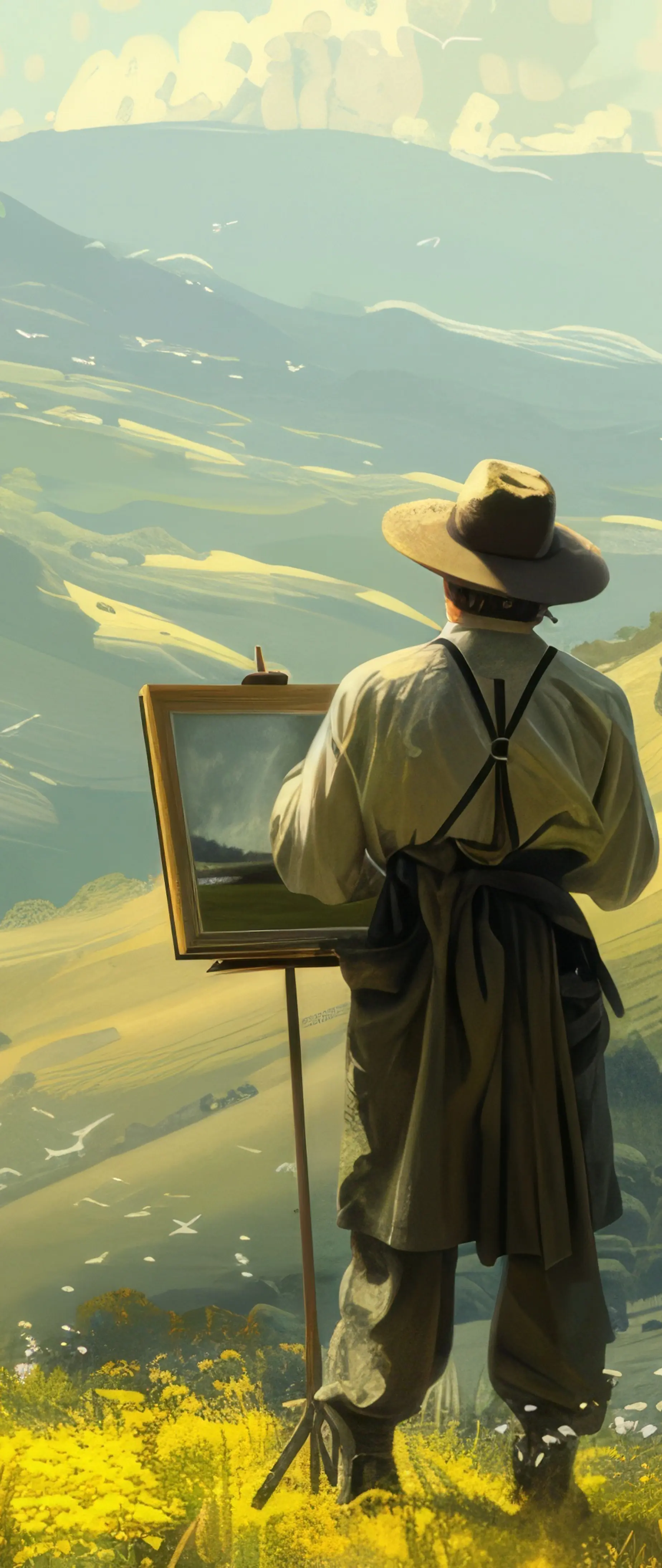
Painting in the open air · Somewhere in Himalayas!
HIMALAYAN PLEIN-AIR
Where artists from various fields from India and International countries meet in the Himalayas.
The practice
What is plein-air?
En plein air is French for “in the open air”. It means leaving the studio and painting outdoors, directly in front of the subject, working while the light, weather and shadows change around you.
-
Painting from lifeNo photographs, no memory: the subject is right there, and every mark answers to it.
-
Chasing the lightLight moves fast. A plein-air painting records an hour, a season, a particular sky.
-
The landscape as studioWind, heat and passers-by become part of the work, and part of the story it tells.
The practice took hold in nineteenth-century France, when portable box easels and paint in metal tubes let artists carry the studio into the field. The Barbizon painters, and then the Impressionists, made it a way of seeing.
Our story
What is Himalayan Plein-Air?
Set against the grand backdrop of the Himalayas, Himalayan Plein-Air connects artists across diverse mediums with breathtaking alpine landscapes and local hosts, offering structured international residencies—our Editions—alongside slower, immersive stays focused on open-air creation and craft.
“Art becomes the medium; cultural dialogue becomes the lasting outcome.”
Goal
Bring painters from India and around the world to paint the Himalaya directly from life.
Objective
Host residencies and homestays that connect artists with Kangra's landscapes, heritage and communities, and share the work through public exhibitions.
Vision
Art as the medium, and cultural dialogue between nations as the lasting outcome.
About the curator
Arijeet Chanda
Curator & Founder
Arijeet Chanda is an artist, curator, and advocate for open-air creation whose work bridges international artistic traditions and the grand landscapes of the East. Drawing from extensive experience across Europe’s distinguished plein air symposia—including gatherings in Lithuania, Poland, Denmark, and India—he has spearheaded a pioneering vision: establishing a world-class outdoor creative residency across the Himalayan ranges.
Guided by a commitment to cross-cultural dialogue, Arijeet’s initiative brings together an international community of visual artists—from painters and sculptors to woodworkers and tactile creators—to work directly within the majestic valleys, river basins, and sacred sanctuaries of the Himalayas. By weaving global artistic practices with the region's rich cultural heritage, sacred geography, and holistic traditions, he fosters an environment where nature itself becomes both canvas and studio.
Through structured international Editions and slower, community-hosted creative stays, Arijeet aims to build a global platform that redefines how artists interact with landscape, tradition, and cross-border collaboration.